
Portable
Acoustic camera
LeakCam 600
64 MEMS microphones show several leaks at once; a laser measures the distance and calculates l/min and €.
- Microphones
- 64 MEMS, 2…130 kHz
- Sensitivity
- 2 l/h @ 3 m
- Distance
- 0.3…120 m
- Camera
- 13 MP
Leak detection
On average, around a quarter of compressed air is lost through leaks. Ultrasonic detectors and the LeakCam 600 camera find even the smallest leaks during production, measure their size in l/min and show the cost in € per year.
Why look for leaks
Unlike a water leak, a compressed air leak is invisible. Even at weekends and during downtime, compressors run just to replace the air that escapes. In older networks, leaks account for 25–35 % of consumption.
Example from the CS Instruments catalogue: a company with 150 kW of compressors, 6,000 operating hours and €0.24/kWh pays €216,000 for electricity per year – 25 % leakage means a loss of €54,000. Joints, quick couplings, hoses and welds leak most often.
CS Instruments models
From an affordable detector for maintenance staff to an acoustic camera that shows all relevant leaks in a room at once.
Acoustic camera
64 MEMS microphones show several leaks at once; a laser measures the distance and calculates l/min and €.

Detector with camera
LD 500 with UltraCam attachment that creates an image of the leak with 30 microphones.

Ultrasonic detector
Detector with camera, laser and leak cost calculation for on-site documentation.
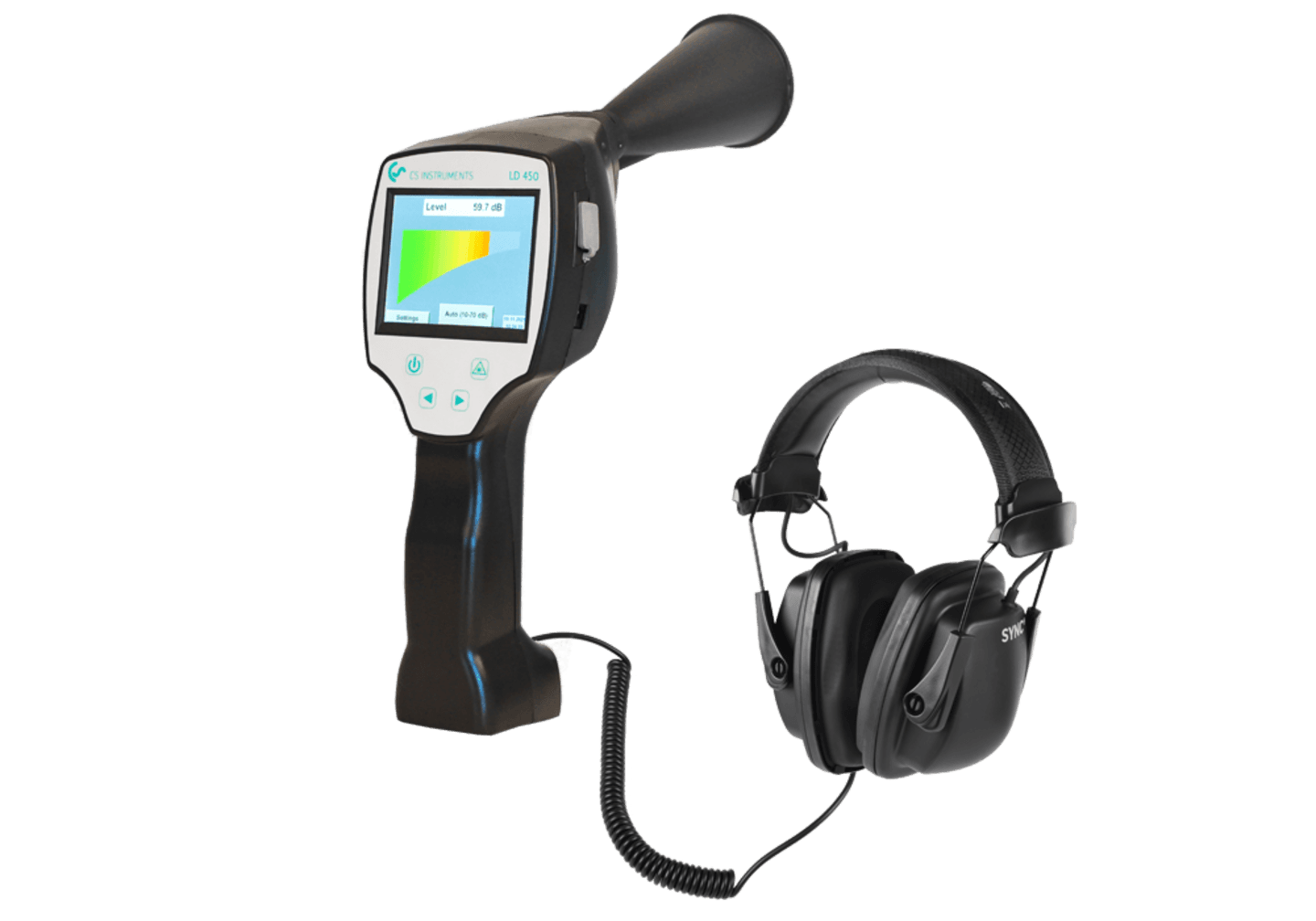
Entry-level detector
Low-cost ultrasonic leak detector for maintenance staff.

ISO 50001 reports
Software for reports on leaks, costs and CO₂ – on a PC or in the cloud.
Software – we help you choose the right licence.
Comparison
| Model | Version | Sensitivity | Frequency | Battery life | Display |
|---|---|---|---|---|---|
| LeakCam 600 | Portable | 2 l/h @ 3 m | – | – | 5″ touch |
| UltraCam LD 500 / 510 | Portable | 0.1 l/min @ 6 bar, 5 m | 40 kHz ± 2 kHz | 6 h | 3.5″ touch |
| LD 500 / LD 510 | Portable | 0.1 l/min @ 6 bar, 5 m | 40 kHz ± 2 kHz | 9 h | 3.5″ touch |
| LD 450 | Portable | – | 40 kHz ± 2 kHz | > 10 h | – |
| CS Leak Reporter | Software | – | – | – | – |
Loss calculator
Choose the size and number of leaks and the network pressure. The calculator uses the leakage cost table from the CS Instruments catalogue.
14,440 €
The calculation is based on the leakage cost table in the CS Instruments catalogue (1.9 ct/Nm³, 24 h × 365 days) and is an estimate only. The LD 500 or LeakCam 600 measures the exact size of each leak.
Inspect the network during operation with a detector or camera and tag the leaks.
Save a photo, size in l/min, cost, location and required spare part on the spot.
Prioritise repairs by cost. Use a flow meter to verify how much consumption has dropped.
How to choose
For occasional checks the LD 450 is enough, for regular inspections the LD 500 with cost calculation.
The LeakCam 600 acoustic camera shows several leaks at once and speeds up inspection of large halls.
For ISO 50001 reports choose a device with a camera and the CS Leak Reporter software.
The detectors find leaks in compressed air, gas and vacuum systems – including ammonia and CO₂ refrigeration systems.
FAQ
Gas escaping through a small opening creates ultrasound around 40 kHz, inaudible to humans. The detector picks it up, converts it into an audible signal in the headphones and estimates the leak size from the intensity and distance.
No. The detectors filter out ambient noise, so leaks are found during normal operation.
According to the CS Instruments table (1.9 ct/Nm³, 24 h × 365 days), a 1 mm leak at 6 bar costs about €632 per year, a 3 mm leak already about €5,685.
The LD 500 has a directional microphone and a camera for documentation – you find leaks one by one. The LeakCam 600 has 64 MEMS microphones and shows several leaks on screen at once, so it is faster for inspecting large areas.
Yes. With the CS Leak Reporter software (on a PC or in the cloud) you create a report with the number of leaks, total leakage in l/min, costs and CO₂ per year.
Related measurements
Fill in a short form and we will prepare a proposal for measurement equipment and implementation based on the medium, measuring range, and measurement objective.