

- Home
- Vacuum and blowers
- Elmo Rietschle
- Liquid ring pumps
Elmo Rietschle · L-Series
Liquid ring L-Series.
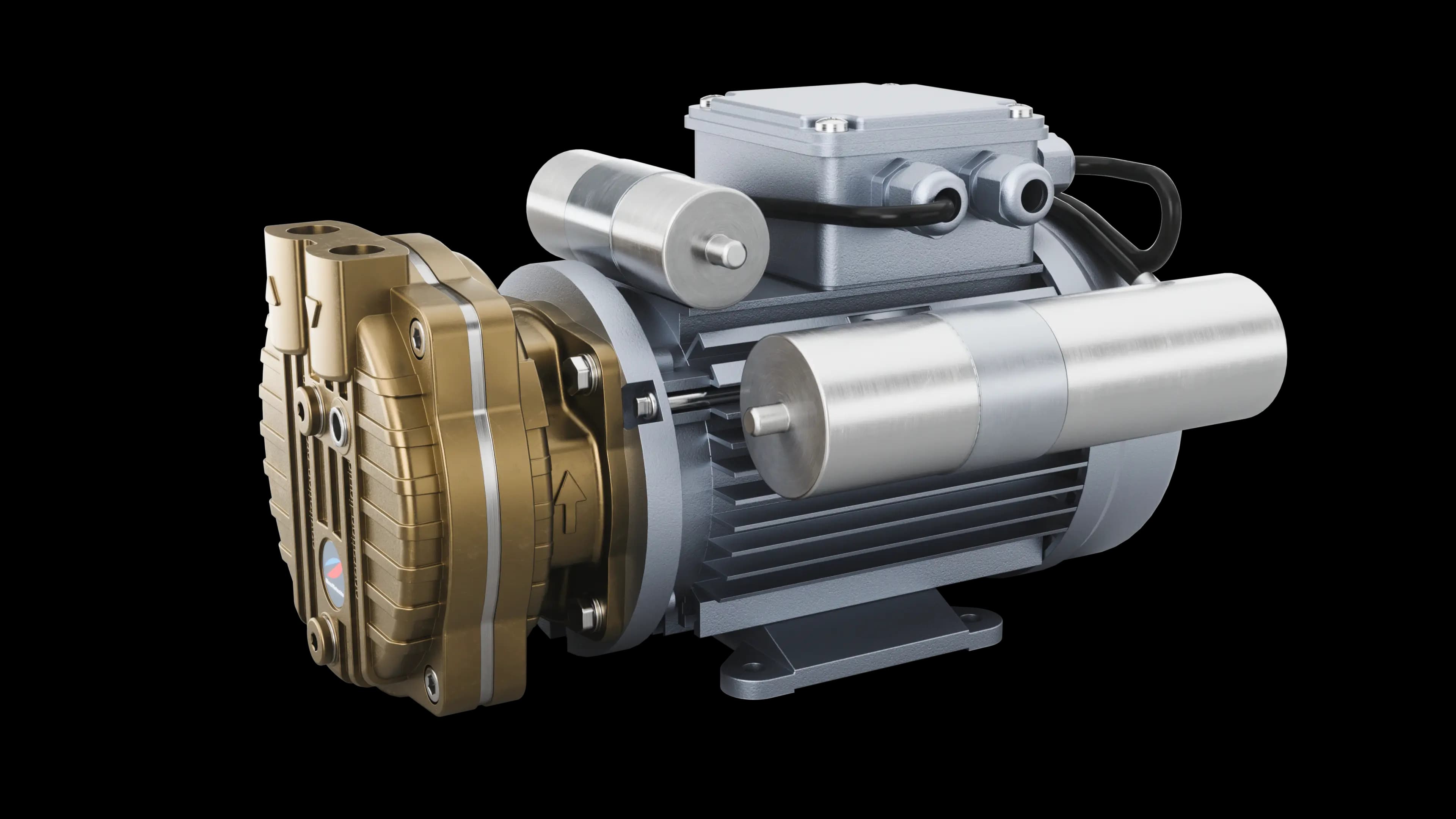
Monoblock vacuum pumps and compressors for humid, contaminated and explosive gases, plus compact L-BL2 packages with a closed liquid circuit. Stainless steel shafts and a ceramic internal coating prevent limescale and corrosion.

- ultimate vacuum
- 33 mbar(a)
- capacity up to (L-BV5)
- 600 m³/h
- series available
- 5

Operating principle
Liquid seals, gas is compressed.
The impeller (4) is the only moving part of the pump and turns without contact in the casing (2). A rotating liquid ring (1) seals the impeller at the front and seals the blades against one another.
- Gas flows through the inlet slot (6) into the cells between the blades.
- Because the impeller sits eccentrically in the casing, the volume of the cells (5) changes during rotation – the gas is compressed within one revolution.
- Some liquid is continuously drawn into the compression chamber and expelled with the gas (3); this keeps the liquid ring stable.
- Vapour in the gas condenses and is separated. The volume drops, so the effective pumping capacity increases.
Advantages
Why L-Series pumps.
- Made for wet processes
They safely handle vapour, condensate and liquid – moisture is no problem.
- No limescale
The ceramic internal coating of the casing prevents deposits and keeps performance up for years.
- Corrosion resistant
Stainless steel shafts; casings in stainless steel, bronze or cast iron with ceramic coating.
- Up to 50 % less water
The L-BV7 and L-BV2 use up to half the operating liquid.
- High liquid carry-over
The L-BV54 handles up to 6 m³/h of liquid – a pre-separator is often unnecessary.
- No continuous water supply
The L-BL2 “Pump in a Box” with a patented exhaust air cooler runs without continuous fresh water make-up.
Series
Liquid ring series.
Click a series for technical data, versions and an enquiry.


Applications
Where they are used.
Food and beverage
- Dairy industry
- Filling plants and PET bottle filling
- Beverage degassing
- Sugar production
Medical
- Steam sterilisation (autoclaves)
- Central vacuum systems
Plastics and ceramics
- Extruder degassing
- Calibration
- EPS foaming
- Degassing in the ceramic and brick industry
Environment and processes
- Solvent recovery
- Vacuum tankers
- Hydraulic oil filtration
- Drying systems
Choosing the technology
When to choose liquid ring pumps?
The right choice when
- The gas is very humid or carries liquid
- The medium is contaminated, aggressive or explosive
- A vacuum down to 33 mbar(a) is enough
- You want a robust solution with a single moving part
FAQ
Questions and answers.
How does a liquid ring pump work?
An eccentrically mounted impeller spins the operating liquid (usually water) into a liquid ring. Cells form between the blades whose volume changes during each revolution – gas is drawn in and compressed without metal-to-metal contact.
How much water does it use?
It depends on size and temperature. The L-BV7 and L-BV2 use up to 50 % less liquid, and L-BL2 packages run in a closed circuit without continuous water make-up.
What is the L-BL2 “Pump in a Box”?
A portable, air-cooled unit with an L-BV pump, motor, separator, seal water cooler and exhaust air cooler. Connect the suction line and motor, fill the tank – and it is ready.
Can the pump work as a compressor?
Yes. Because the pump always creates a pressure difference in operation, it can also compress gas drawn from the surroundings.
Tell us your requirements and we will propose the right solution.
Fill in a short form and we will prepare a proposal for a vacuum pump or blower based on flow, pressure, and operating conditions. If needed, we can also include filtration, silencers, and accessories.