

- Home
- Vacuum and blowers
- Elmo Rietschle
- Rotary lobe pumps
Elmo Rietschle · R-Series
Rotary lobe R-Series.
Dry rotary lobe (Roots) vacuum pumps as boosters on rotary vane, screw or claw pumps, complete pump stands for fine vacuum and blowers for high flows.
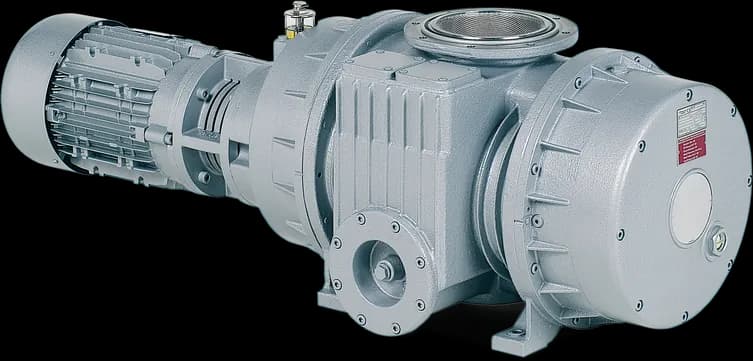
- ultimate vacuum (pump stand)
- 0.01 mbar(a)
- capacity up to
- 10,000 m³/h
- series available
- 5
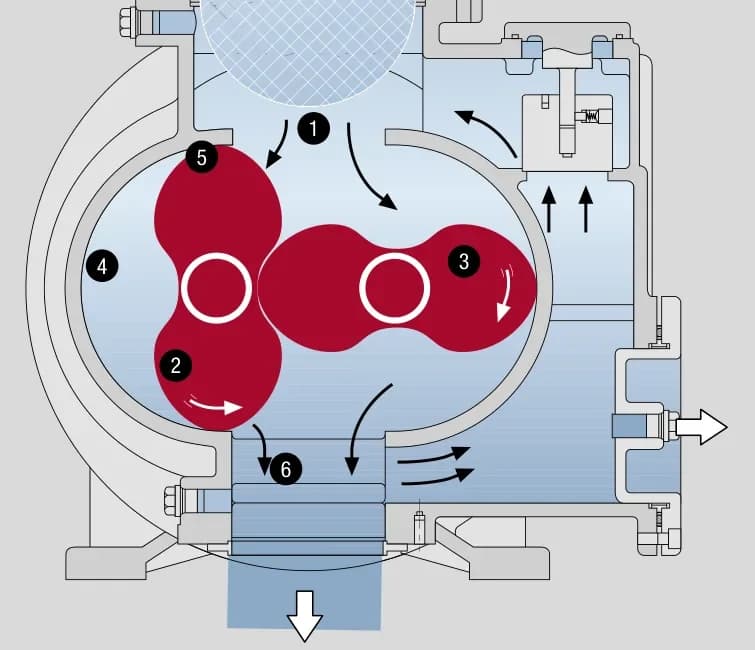
Operating principle
Conveying without internal compression.
Rotary lobe pumps are static compression systems, but without “internal” volume reduction. As the lobes never touch, the pumped gas cannot be contaminated.
- Air enters through the inlet (1) into a cell formed by the two lobes (2, 3) in the housing.
- The following lobe tip (5) separates the cell from the inlet; the air in the cell (4) is conveyed without any reduction in volume.
- When the cell reaches the outlet (6), gas at higher pressure flows back in from the pressure side – this is where “external compression” takes place.
- The R-VWP does not discharge to atmosphere but into the inlet of a backing pump, for example a rotary vane pump. Together they reach deep vacuum and high capacity.
Advantages
Why Elmo Rietschle rotary lobe pumps.
- More capacity, fewer machines
A booster increases the flow of an existing vacuum system without extra pumps.
- Lower energy use
A booster with backing pump uses less energy than several standalone machines.
- Dry and contact-free
The compression chamber is free of grease and oil; oil is only in the separate gear and bearing housing.
- Vapour tolerant
The R-VWP handles water vapour and most corrosive gases.
- Safe start-up
An integrated bypass valve lets the booster start together with the backing pump without overloading the motor.
- Modular and ATEX
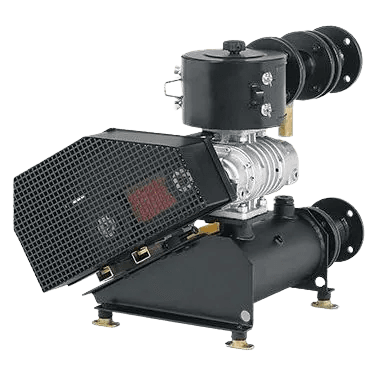
R-VPR pump stands (with oil-lubricated vane pump) and R-VPA (with once-through lubrication), also in ATEX versions.
Series
Rotary lobe series.
Click a series for technical data, versions and an enquiry.



Applications
Where they are used.
Processes and chemicals
- Chemical industry
- Pharmaceuticals
- Drying and process engineering
- Research and laboratories
Metallurgy and surfaces
- Industrial furnaces
- Metallurgy
- Coating technologies
- Electronics
Environment and water
- Waste water treatment
- Tank and sludge aeration
- Vacuum tankers
- Vacuum sewage systems
Central systems and conveying
- Central vacuum systems
- Pneumatic conveying
- Food industry
- Woodworking industry
Choosing the technology
When to choose rotary lobe pumps?
The right choice when
- You need deep vacuum and high suction capacity at the same time
- You want to boost the capacity of an existing vane, screw or claw pump
- It is industrial fine vacuum, furnaces or chemical processes
- You need a blower for flows above 3,000 m³/h
FAQ
Questions and answers.
What is a vacuum booster?
A rotary lobe pump installed upstream of a backing pump (rotary vane, screw or claw). It discharges into the backing pump instead of to atmosphere, so the combination reaches higher capacity and deeper vacuum.
Which R-VWP booster sizes are available?
The R-VWP range covers 485 to 2,752 m³/h. The new R-VWP 501, 1001 and 2001 boosters have nominal capacities of 500, 1,000 and 2,000 m³/h and a differential pressure of 60 mbar across the overflow valve.
What is the difference between the R-VPR and R-VPA?
The R-VPR is a pump stand with an oil-lubricated V-VC rotary vane backing pump for industrial fine vacuum. The R-VPA uses a once-through lubricated V-VWZ rotary vane pump and is intended for evacuation in industrial and chemical processes.
Does the R-Series include blowers?
Yes. The R-WVB for vacuum up to 10,000 m³/h and the R-WPB for overpressure with differential pressure up to 1,000 mbar.
Tell us your requirements and we will propose the right solution.
Fill in a short form and we will prepare a proposal for a vacuum pump or blower based on flow, pressure, and operating conditions. If needed, we can also include filtration, silencers, and accessories.