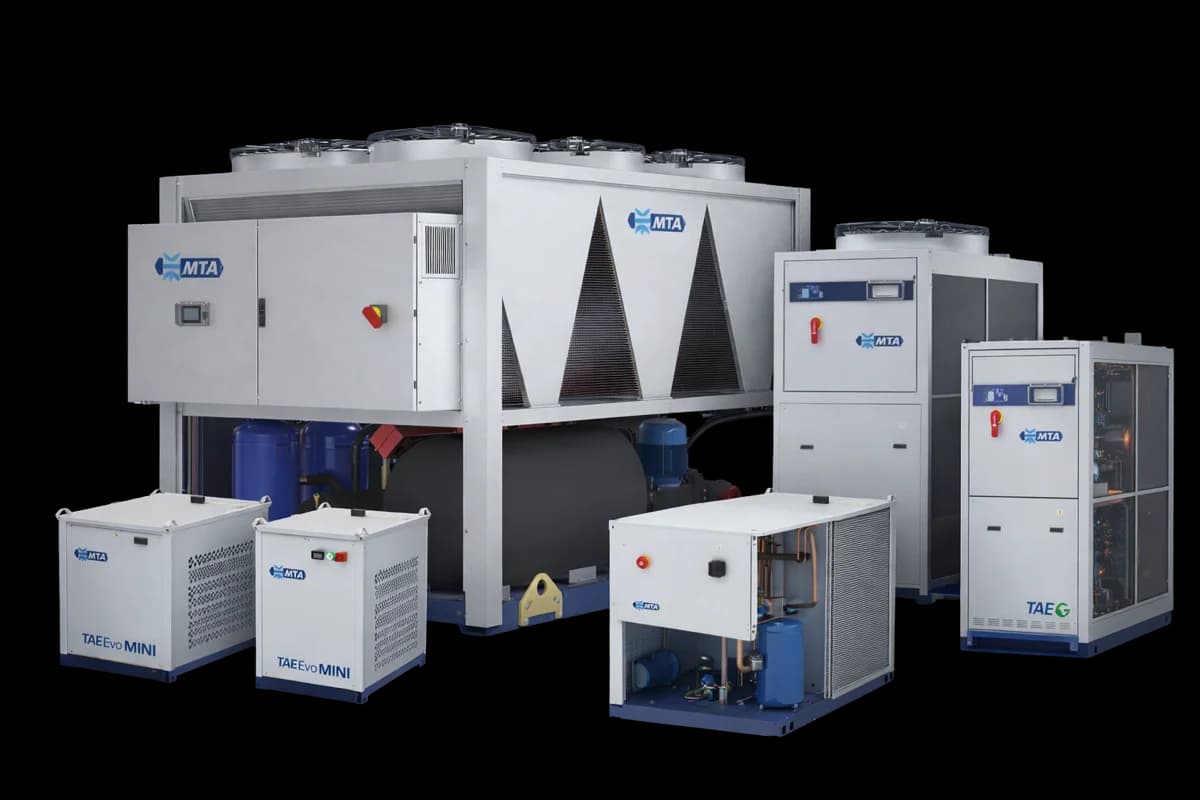
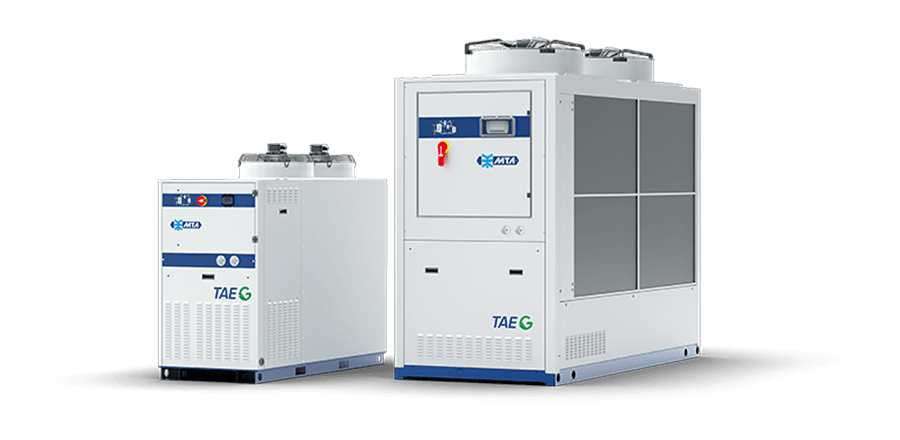
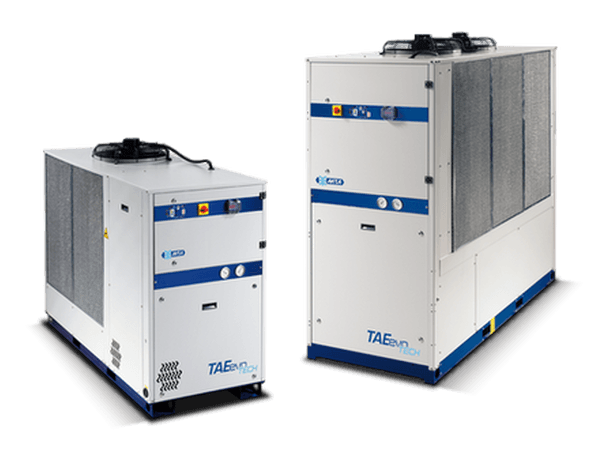
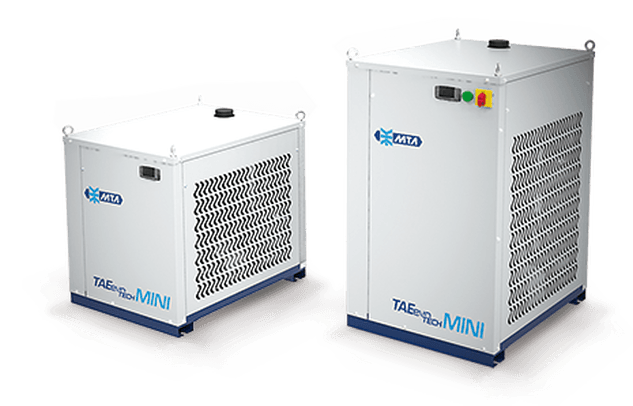
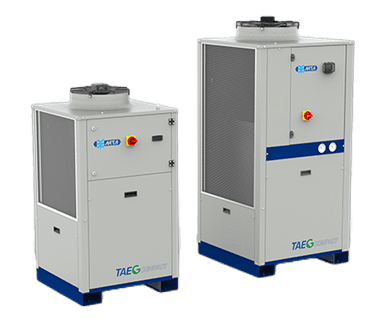
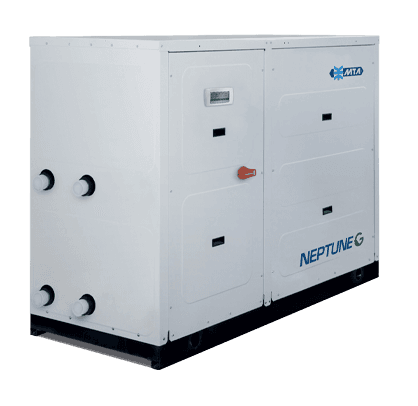
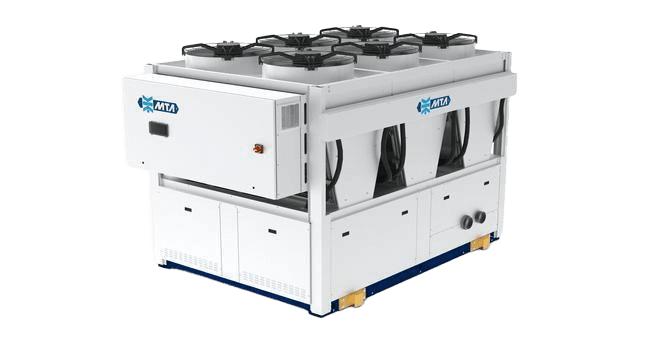
MTA process chillers – TAEevo Tech MINI, TAE G and a large air-cooled chiller
  1. KOMP-R
  2. Industrial cooling
  3. Process cooling

MTAProcess cooling

Stable process temperature. From 1.7 to 695 kW.

MTA industrial chillers for machines, moulds and production processes. Air- or water-cooled, with an evaporator-in-tank design, leaving water down to −24 °C and control to ±0.5 °C.

series of process chillers
10
nominal cooling capacity
1.7–695kW
lowest leaving temperature (TAEevo LWT)
−24°C
accuracy of the Close Control version
±0.5°C

Calculation

How much cooling capacity does your process need?

Enter the process fluid flow, the temperature at which it returns from the machine and the temperature you want. The calculation shows the heat load and the MTA series that cover it.

Process data

°C
°C
Ethylene glycol share

Q = V × c × ΔT = 1.67 l/s × 4.19 kJ/(l·K) × 5 K = 34.9 kW

Process heat load

34.9kW

With a 10 % margin we select for 38.4 kW

Matching series (5):

Indicative calculation. Nominal capacities per EN 14511 at 20/15 °C and 25 °C ambient; at lower leaving temperatures, higher ambient temperatures or with glycol the unit capacity is lower. We make the exact selection with MTA software.

Technology

Built for the process, not for the office

A process chiller has to hold the temperature even when the machine load changes within seconds. That is why MTA series include solutions that comfort chillers do not have.

Evaporator in the tank

The finned evaporator is immersed in the water tank. It allows high flow rates with low pressure drop, absorbs load peaks and tolerates contaminated process fluid.

TAE N MINI · TAEevo Tech MINI · TAE G Compact · TAE G · TAEevo Tech · TWEevo Tech

Close Control ±0.5 °C

The close temperature control version keeps the leaving temperature within a ±0.5 °C hysteresis – for lasers, measuring equipment and processes that cannot tolerate fluctuations.

TAEevo Tech (020–351) · TAEevo Tech MINI (M08–M10)

Low temperatures

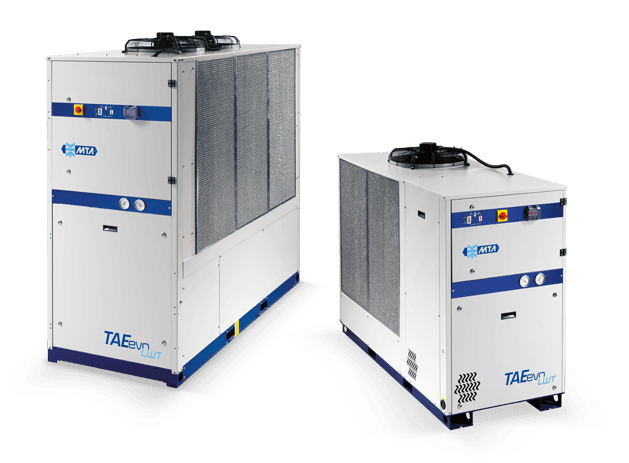
For glycol circuits, cold stores and wineries: leaving temperatures down to −10 °C in the standard series and down to −24 °C with TAEevo LWT.

TAEevo LWT · TAE G · TAEevo Tech · TWEevo Tech
Non-ferrous hydraulic circuit

Tank, piping and pump without ferrous materials keep the fluid clean. Essential for laser sources, pharmaceuticals and food, where rust or scale are not acceptable.

Option for TAEevo Tech and TAEevo Tech MINI

Tailored hydraulics

P3 or P5 pumps, twin stand-by pumps, internal bypass, automatic filling and operation in open or pressurised circuits up to 6 barg.

TAEevo Tech · TAEevo LWT · TAE G · TWEevo Tech

Supervision and connectivity

RS485 Modbus, the xWEB300D EVO supervision system and up to 5 identical units in master/slave mode for redundancy and more capacity.

TAEevo Tech · TAE G · TWEevo Tech

Comparison

All process chiller series

Key data in one place. Click a series to open its product page with the technical table and brochure.

SeriesCondenserCooling capacityMin. leaving waterRefrigerantCompressorHighlights
MTA TAE N MINIAir1.7–4.4 kW0 °CR290rotaryNatural refrigerant
MTA TAEevo Tech MINIAir1.8–4.4 kW−5 °CR134a · R410ArotaryNon-ferrous circuit
MTA TAEevo LWTAir4.5–52.5 kW−24 °CR449AscrollDown to −24 °C
MTA TAE G CompactAir6–23 kW−5 °CR513AscrollCompact
MTA TAE GAir7–254 kW−10 °CR513A · R454BscrollLow GWP
MTA TAEevo TechAir8–259 kW−10 °CR410AscrollEvaporator-in-tank
MTA TWEevo TechWater12.4–191.7 kW−10 °CR410AscrollEvaporator-in-tank
MTA CYGNUS GAir26.7–80.8 kW−5 °CR454BscrollLow GWP
MTA NEPTUNE GWater52–695 kW–R454BscrollReversible
MTA ARIES G FCAir160–340 kW–R454BscrollFree-cooling

Cooling capacity: nominal range of the series per EN 14511. Min. leaving water: lowest temperature of the series or its low-temperature version (with glycol). – = data available on request.

Free-cooling in practice

39 % less electricity, payback in 18 months

An example from the MTA catalogue: an FC TAE 161 module is added to an existing TAEevo Tech 161 chiller. Whenever it is colder outside than the process water, ambient air removes the heat.

Cooling capacity
53 kW
Chilled water temperature
15 °C
Operation
16 h/day, 5 days/week, 45 weeks/year
Reference city
Berlin
39 %energy saving
18 monthspayback time
Chiller only100 %
Chiller + FC TAE61 %

Source: MTA Product Guide Industrial Process Cooling (04-2021). We run the calculation for your location and operating profile with MTA software.

Applications

Where MTA process chillers shorten cycles and reduce scrap

The right process fluid temperature directly affects product quality, cycle time and machine life.

Plastics and rubber

Cooling of moulds, injection moulding hydraulics, extrusion heads, rolls and thermoforming dies. Even temperatures mean fewer surface defects and shorter cycles.

Lasers

CO₂, fibre and diode lasers need a stable temperature for a constant wavelength and beam quality. The non-ferrous circuit protects the source and optics.

Machine tools

Spindles, cutting oils and hydraulics. Precise cooling maintains dimensional accuracy, extends tool life and reduces scrap.

Food and beverage

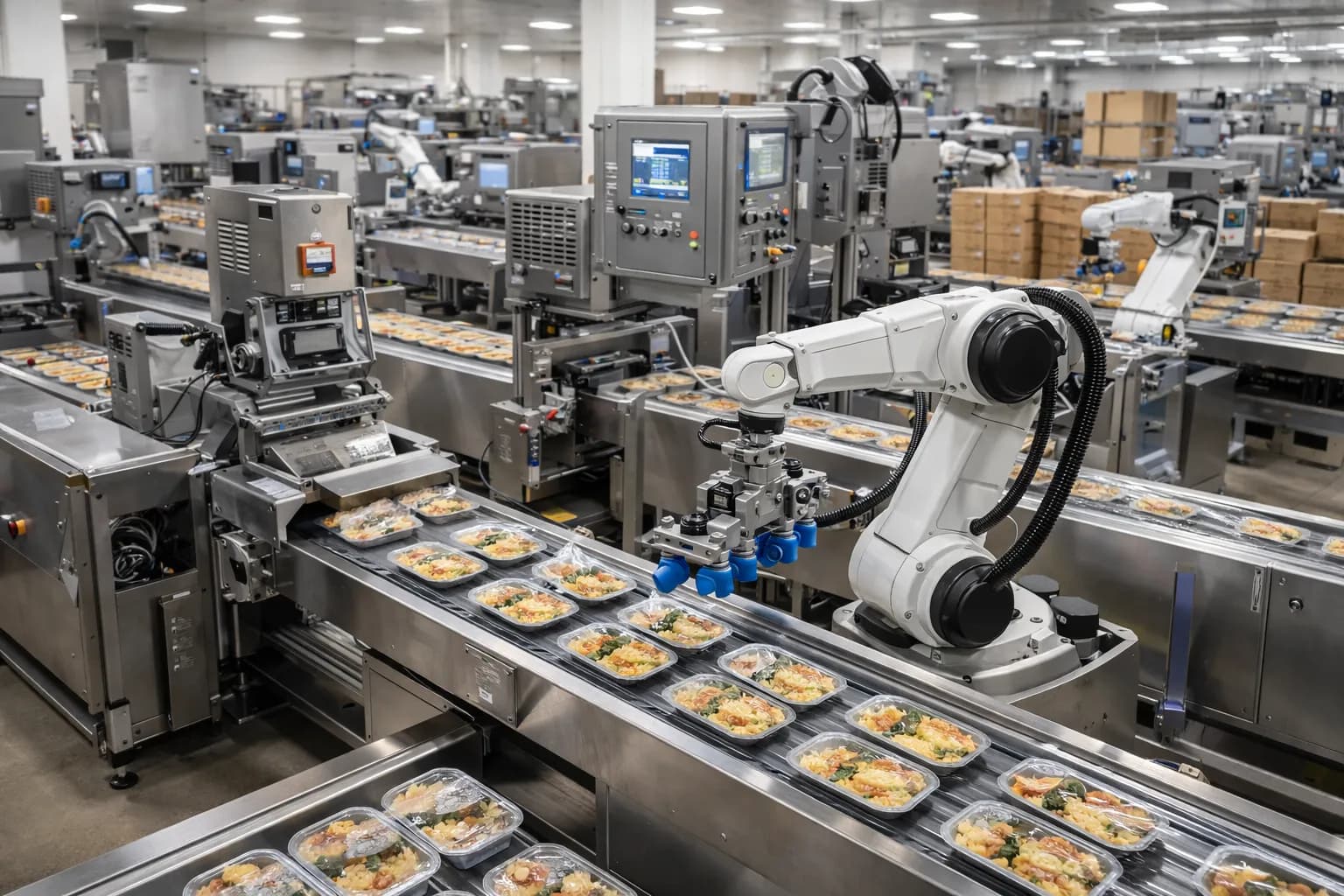
Dairies, breweries, bakeries, meat and vegetable processing. Direct or indirect glycol cooling and hygienic stainless steel versions.

Winemaking

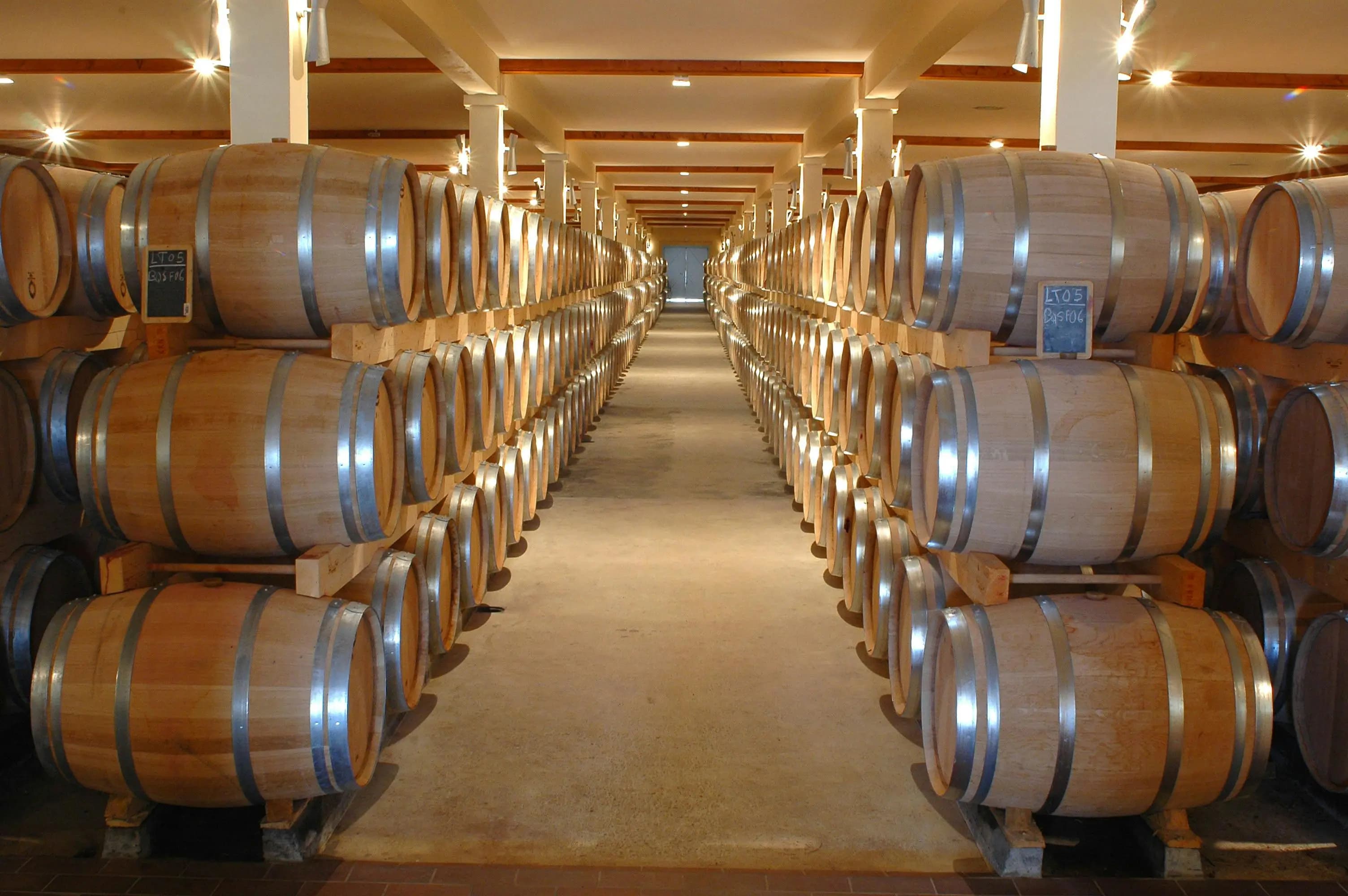
Fermentation control, cooling of storage vats, must clarification and cold tartaric stabilisation below 0 °C.

Chemicals and pharmaceuticals

Jacketed reactors, mixers, laboratories and solvents. Redundant refrigerant circuits and fast capacity adjustment when the process changes.

Compressed air and gases

Cooling of technical gases, pre-treatment of biogas and natural gas, and dew point control of compressed air with a chiller and heat exchanger.

Metals and surface treatment

Heat treatment, welding machines, galvanic and coating baths and aluminium processing – a stable temperature for repeatable results.

KOMP-R + MTA

From calculation to service

A chiller is only part of the system. KOMP-R takes care of the whole – with original parts and MTA factory support.

  1. 1

    Calculation and selection

    From your data (kW, temperatures, fluid, operation) we select the series and version, with free-cooling where it pays off.

  2. 2

    Hydraulics and installation

    Pumps, tanks, glycol, pipework and outdoor or indoor installation.

  3. 3

    Commissioning

    Setting up control, protections and supervision, and handover with operating instructions.

  4. 4

    Service and maintenance

    Regular inspections, condenser cleaning, leak checks and fast delivery of spare parts.

FAQ

Questions about process cooling

How do I calculate the required cooling capacity?

From the process fluid flow and the temperature difference: Q = V × c × ΔT. For water c ≈ 4.19 kJ/(l·K), so 100 l/min cooled from 20 to 15 °C is about 35 kW. Add a 10–20 % margin. If you do not know the flow, we start from the machine data – for example the power of the hydraulic unit or the consumption of the laser.

When do I need glycol?

When the required leaving temperature is below about +5 °C, or when the chiller and piping are outdoors in winter. 30 % ethylene glycol protects the circuit to about −15 °C, but it lowers the heat capacity of the fluid and the chiller capacity – we take this into account in the selection.

Air-cooled or water-cooled condenser?

An air-cooled chiller rejects heat to the ambient air and is the simplest to install outdoors. A water-cooled one (TWEevo Tech, NEPTUNE G) suits sites with a cooling tower, well water or a heat recovery circuit – it is compact, quiet and suitable for indoor installation.

Why does the tank in the chiller matter?

The tank absorbs fast load changes, so the compressor does not cycle too often and the temperature stays stable. In MTA units the evaporator is immersed in the tank, so it handles high flow rates and less clean process fluid.

Can the chiller be connected to an existing circuit?

Yes. MTA chillers work in open (atmospheric) or closed pressurised circuits up to 6 barg. The internal bypass protects the pump, and manual or automatic filling kits simplify the connection. Before quoting we check flows, pressure drops and water quality.

Does free cooling pay off in Central Europe?

Often yes – especially with process water at 15 °C or more and year-round operation. When it is colder outside than the return water, the ambient air cools it while the compressors rest. In the example from the MTA catalogue the saving was 39 %; we calculate it for your location and operating hours.

Industrial cooling

Describe your process and we will propose the right solution.

Fill in a short form and we will prepare a configuration proposal based on load profile, environment, and energy efficiency goals.

Sizing based on real operating loads
Energy consumption optimization
Supply, installation, and service
Contact form
* required fields
Your message is sent directly to our email inbox.
Where to find us
Directions
Pod lipami 4 · 1370 Logatec, Slovenija